Essay completed for ‘Film and TV History’ 13th December 2022
History and social change during the 1930-50s In American cinema changed and developed dramatically as a result of the Great Depression, world wars and certain creators who had visions on what they wished to pursue in film as a whole. In this argument, I will discuss the films: ‘Heidi’, directed by Allan Dwan and ‘The Diary of Anne Frank’, directed by George Stevens. With both these examples, we will be able to dive deeper into why cinema in the United States made histories factors in association with film texts, and continually throughout the film industry as a whole.
In relation to the two examples of films that were in production after the great Hollywood depression, they both simultaneously describe the formations of cinema during both time periods respectively. During the early adaptions of Hollywood, there has been a number of cases indulging in the financial stakes that include: the ‘Wall Street Crash in 1929 (Schindler, 2005). (Schindler) informed us that this crash started to invest in a substantial amount of money towards the movie business. ‘The Golden Age’ took place right in the centre of the ‘Great Depression’. If we dive deeper into this specific era, between sixty and eighty million citizens in the united states would attend their local theatre regularly as a way of escapism. (Whitington, 2008). The film industry successfully distracted the minds of the public during the crash. Citizens were desperate for not spending an exquisite amount of money, but were fortunate enough to purchase a ticket to escapism as a way to distract their mind of their unfortunate reality. (Ettleman, 21).
‘Heidi’, directed by Allan Dwan, brought out one of the most successful child stars in classical Hollywood cinema, Shirley Temple. (Grant, n.d.) According to . (Grant), the representation of women, (even at such a young age) would still feel the mandatory pressure of hair being dramatically changed and the attire in addition to theme and setting of the film. During the production of Heidi, Temple was forced to wear a badge, indicating she was the main star of the film. While the other children wore badges defining them as obeying Temple on set no matter what. Letting children be children, instead of adult rules. (Lowne, n.d.) According to Lowne, Dwan encouraged Temple to act as a regular eight year-old girl represented in the mid-late 1930s.
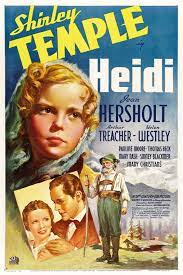
The majority of the mountain scenes were filmed in Lake Arrowhead, California; which some of those scenes were filmed the great outdoors instead of the typical Hollywood studio that would be transformed to have all the scenes filmed inside (Jnpickens, 2019). Due to the extradentary mind of D.W. Griffith, shots like close-ups, chase scenes and frame positions were thought throughout by Dwan as this was his first film directing the young child star. Heidi and the majority of Temple’s films were produced by 20th Century Fox, with Warner Bros, Paramount and MGM in major competition at the time. But with popularity, transformed to multiple films with similar storylines. Nevertheless, stars would be in demand on producers lists as major boxed ticked for their next successful production.
The ’villains’ in 1930s films were demonstrated as characters who had no control of the consequences the film would set out for them to receive. (Whitington, 2008). From this article, (Whitington) established that due to a new description for law and government displayed in film, it became quite popular very quickly for companies (especially Warner Bros) to produce content in relation to this new trend.
Cinematic language changed dramatically between the 1930s-40s. A lot of different types of film were trending during that time. For example: gangster, burlesque, comedy, western and especially physiological dramas (André Bazin et al., 2005). The language used in film during that period had to be sufficient to be the audience and how pleasing the views with their genres will increase their value of ticket sales as it was the most important solutions for income during the great depression. However, along with the genre, sound and cinematography played a major role in gross sales. (Bazin et al., 2005) argued that themes for which an artistic expression would be demonstrated on screen, would advertise and engage in current events and encourage people remain at peace pre and post war time. Due to elements of film participating in war effort; which led to awards both physiological and economical.
Elements of composition were brought to vision by the filmmaker. Film was initially represented by the reality of the audience viewing the feature/reel during a specific time taking place. (André Bazin et al., 2005) (Bazin, 2005) explains that the birth of new cinema was the result of including a soundtrack to post-production. An advantage to this is taking the cost of hiring a skill band or orchestra to accompanying film in its entirety. From the 1920s up to the 1950s, an amount of cinematic values in relation to the evolution of sound films. The approach regarding cinematography created different styles and stories instead to complete failure. Film was considered art due to montage, “It was montage that gave birth to film as an art”. (André Bazin et al., 2005, p.42). By then a photographic image wasn’t enough to entertain the hearts of the public. Sound formally became classically perfect between 1938-1939, just before WWII broke out. When the second world war commenced, (Bazin et al., 2005) commented that the film industry was associated with a river; where it would flow from the mouth, all the way towards the goal/end of the industry. With Soviet films playing a considerable part in American film history, there was a number of artists who travelled from multiple parts of Europe (due to the outbreak of both world wars), with such creative vision who felt more comfort and unbounded from their epic change of reality. In relation to ‘Mise-en-Scène’, which defines as the most creative and impactful was to imagine a powerful moment on screen (STUDIOBINDER, 2018), can be identified with shadows, patterns on the walls from different sets, costumes for characters (example being women in Heidi wearing multi-colour scarves and fitted gowns). But lighting played a crucial part in production, especially in the 1930s onwards. (Thompson and Bordwell, 2010, pp.119–125)
American cinema in the 1950s, the majority of the content produced was post-war related as an influence. Nearly the whole nation was aware and also affected by the damaged done by the Nazi’s. Audiences wanted more realistic representation from the content they were watching (Dirks, 2010). In the ‘Diary of Anne Frank’ directed by George Stevens, we witness teenage popularity grow as well as more availability in wider genres for every nation in multiple locations to engage in. In 1953, we witnessed the expansion of Hollywood shooting in locations outside of their motherland. This however was due to tax advantages and not initially by desire (Bordwell et al, 1985).
The character of Anne Frank, played by Millie Perkins, was one of the first and youngest Jewish female character representation post-war period. Teenage honour ship was a great example in relation to this argument. With the information written by (Pfeiffer, n.d), Stevens was made very aware of the horrifying events that took place during the films setting. So he decided to only have one main location instead to capturing the scenes that would be thready disturbing for some viewers. With serval nominations and ‘Academy Awards’ under its belt, this film was ahead of its time composition wise. But then again, American audiences wanted to reimagine realism, but in addition with expressionism and mise-en-scène that has a number of examples throughout the film. For example the grids demonstrated by the sets architecture has the setting made exquisitely from beginning to end (Deutelbaum, 2022).
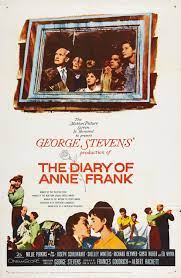
With relatability also well planned out, both films both explains the POV (point of view) of both female characters throughout. In addition to this, human heroism has been displayed carefully, with humanitarian events that audiences wouldn’t be able to describe very well until they witness it first-hand (Crowther, 1996).
In concluding this discussion, I would argue that the great depression played a significant role in how the golden age of cinema was fortunate enough to continue due to the wall street crash. Shirley Temple, and many other film stars in the 1930-40s were considered an object to society for representing female perfection with entertainment. Every development of a character was thought throughout in addition to character biography demonstrated on screen. The dramatic change of cinematic language, for example montage and genre choice. How the roles of both world wars played a dramatic chapter in the change for more realism in American cinema, and representation of female POVs in both eras, making it more exciting and engaging to watch. In my opinion, the changes made to American cinema during the 1930-50s improved the way we compare and contrast motion pictures and capturing to possibilities in what cinema was able to influence the public and believe certain historical events would dramatically evolve overtime.
References
- André Bazin, Gray, H., François Truffaut and Andrew, D. (2005). What is cinema? / Volume 2. Berkeley: University Of California Press. ‘it was montage that gave birth to film as an art’.
- Bordwell, D., Staiger, J. and Thompson, K. (1985). The classical Hollywood cinema : film style & mode of production to 1960. London ; New York: Routledge, Taylor & Francis Group.
- Crowther, B. (1996). An Eloquent ‘Diary of Anne Frank’; Stevens Is Director of Film at Palace. The New York Times. [online] 19 Mar. Available at: https://www.nytimes.com/1959/03/19/archives/an-eloquent-diary-of-anne-frank-stevens-is-director-of-film-at.html [Accessed 7 Dec. 2022].
- Deutelbaum, M. (2022). Organized Clutter: The Precise Composition of The Diary of Anne Frank (1959): Mise-en-scène: The Journal of Film & Visual Narration, [online] 7(1). Available at: https://journals.kpu.ca/index.php/msq/article/view/1671 [Accessed 6 Dec. 2022].
- Dirks, T. (2010). Film History of the 1950s. [online] Filmsite.org. Available at: https://www.filmsite.org/50sintro.html [Accessed 7 Dec. 2022].
- Ettleman, T. (2021). Hollywood and the Great Depression: The Impact of Economics on Film History. [online] Medium. Available at: https://trettleman.medium.com/hollywood-and-the-great-depression-the-impact-of-economics-on-film-history-ea576ee0c7f7 [Accessed 6 Dec. 2022].
- Grant, C. (n.d.). Video Essay: Mechanised Flights: Memories of ‘Heidi’ – Film Ireland Magazine. [online] Film Ireland. Available at: https://filmireland.net/2014/02/12/video-essay-mechanised-flights-memories-of-heidi/ [Accessed 5 Dec. 2022].
- Jnpickens (2019). Musical Monday: Heidi (1937). [online] Comet Over Hollywood. Available at: https://cometoverhollywood.com/2019/12/23/musical-monday-heidi-1937/ [Accessed 5 Dec. 2022].
- Lowne, C. (n.d.). Allan Dwan | American director | Britannica. [online] http://www.britannica.com. Available at: https://www.britannica.com/biography/Allan-Dwan [Accessed 5 Dec. 2022].
- Pfeiffer, L. (n.d.). The Diary of Anne Frank | film by Stevens [1959] | Britannica. [online] http://www.britannica.com. Available at: https://www.britannica.com/topic/The-Diary-of-Anne-Frank-film-1959 [Accessed 8 Dec. 2022].
- Schindler, C. (2005). Hollywood in Crisis. Routledge.
- STUDIOBINDER (2018). What is Mise en Scène in Film: Definition and Examples. [online] StudioBinder. Available at: https://www.studiobinder.com/blog/mise-en-scene/ [Accessed 12 Dec. 2022].
- Thompson, K. and Bordwell, D. (2010). Film History: An Introduction. McGraw-Hill Humanities Social, pp.119–125.
- Whitington, P. (2008). How the Great Depression inspired Hollywood’s golden age. [online] Independent.ie. Available at: https://www.independent.ie/entertainment/movies/how-the-great-depression-inspired-hollywoods-golden-age-26481978.html [Accessed 8 Dec. 2022].


Leave a Reply